
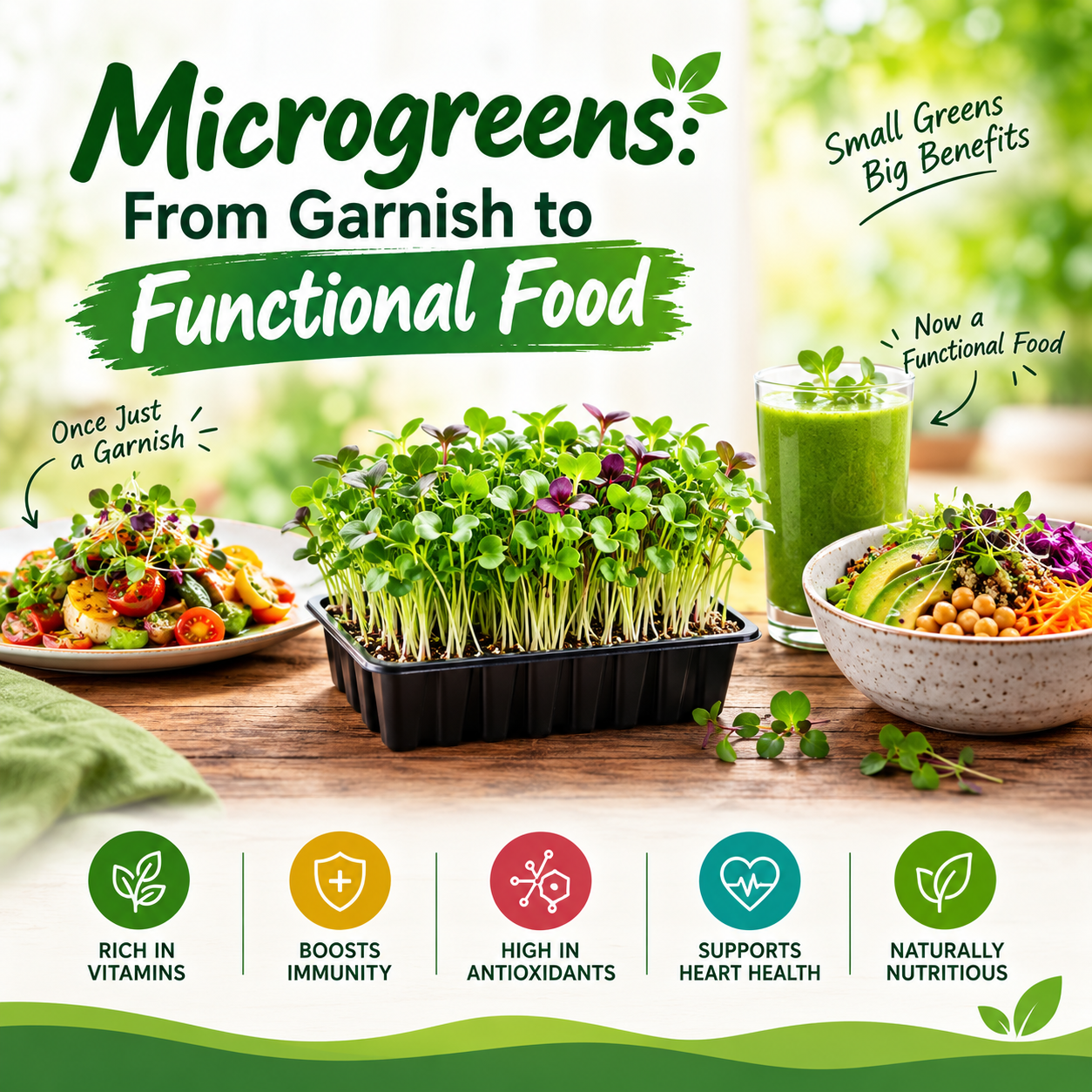
Microgreens have moved from restaurant garnishes to serious horticultural commodities. In India, where micronutrient deficiencies remain a pressing public health concern, these tiny greens offer an unusually efficient pathway from seed to nutrition. Harvested just 7–21 days after germination, microgreens carry a nutrient density 4 to 40 times that of mature plants. For a country where 57% of women suffer from anaemia and micronutrient deficiencies are widespread, this space-efficient, short-cycle crop offers a practical nutritional intervention pathway. The Institute of Horticulture Technology (IHT), with its hands-on training system, is precisely the place to get trained and translate this potential into commercial entrepreneurship.
Nutritional Significance: Small Size, Large Dose
The core value of microgreens lies in their nutrient concentration effect. Because they are harvested at a vigorous growth stage, their leaves accumulate large amounts of vitamins, minerals, and phytochemicals. In mineral comparisons, microgreens show significantly higher levels of calcium, magnesium, iron, manganese, zinc, selenium, and molybdenum than mature lettuce—while nitrate content is lower, making them safer for children and other vulnerable populations.
Specific functional components deserve attention. Brassicaceae microgreens (such as broccoli and red cabbage) are rich in glucosinolates, which produce sulforaphane upon hydrolysis and have shown potential in animal studies for improving insulin resistance and inhibiting colon cancer cell proliferation. Fenugreek microgreens are particularly outstanding for iron content and have demonstrated the ability to enhance cellular glucose uptake by 25% to 44%. Lutein, present in spinach and cress microgreens, is significant for eye health.
The relevance for India is direct. The FAO AGRIS 2025 review notes that Indian women face a dual burden of malnutrition—an underweight rate of 18.7%, an obesity rate of 24.0%, and 57% suffering from anaemia. The high iron, high folate, and high antioxidant profile of microgreens makes them a low-cost, high-efficiency dietary supplement.
Training Is Necessary
The production threshold for microgreens appears low, but commercial success demands precision. Seed density, substrate moisture, light spectrum, and airflow management directly determine yield and mold risk—variables where trial and error are costly. IHT has experience in offering microgreens-specific courses, giving it a ready foundation to build on. For entrepreneurs, mastering these skills means avoiding losses from experimentation.
The value of microgreens lies in nutrition, but the realization of that value lies in technology. IHT’s training system—spanning vertical farming systems as well as horizontal greenhouse production, with a consistent emphasis on practical application—is exactly the bridge connecting “superfood” concepts with the Indian reality of malnutrition.
Contact Us:
Telephone: +91-11-46604988 Phone: +91-8130997511 Email: enquiry@iht.edu.in

Leave A Comment