
In the challenging landscapes of semi-arid and dryland regions, farmers face a constant battle against water stress-drought, soil salinity, and devastating soil-borne diseases. These abiotic and biotic stresses often lead to significant yield losses and financial instability. However, a climate-resilient solution is taking root, promising to transform the productivity and sustainability of horticultural farming. Spearheaded by ICRISAT, Vegetable Grafting and Dryland Horticulture, ICAR- IIVR, IIHR and organizations like VNR, Chhattisgarh and others is a game-changing approach that combines modern science with sustainable practices.
What is Vegetable Grafting?
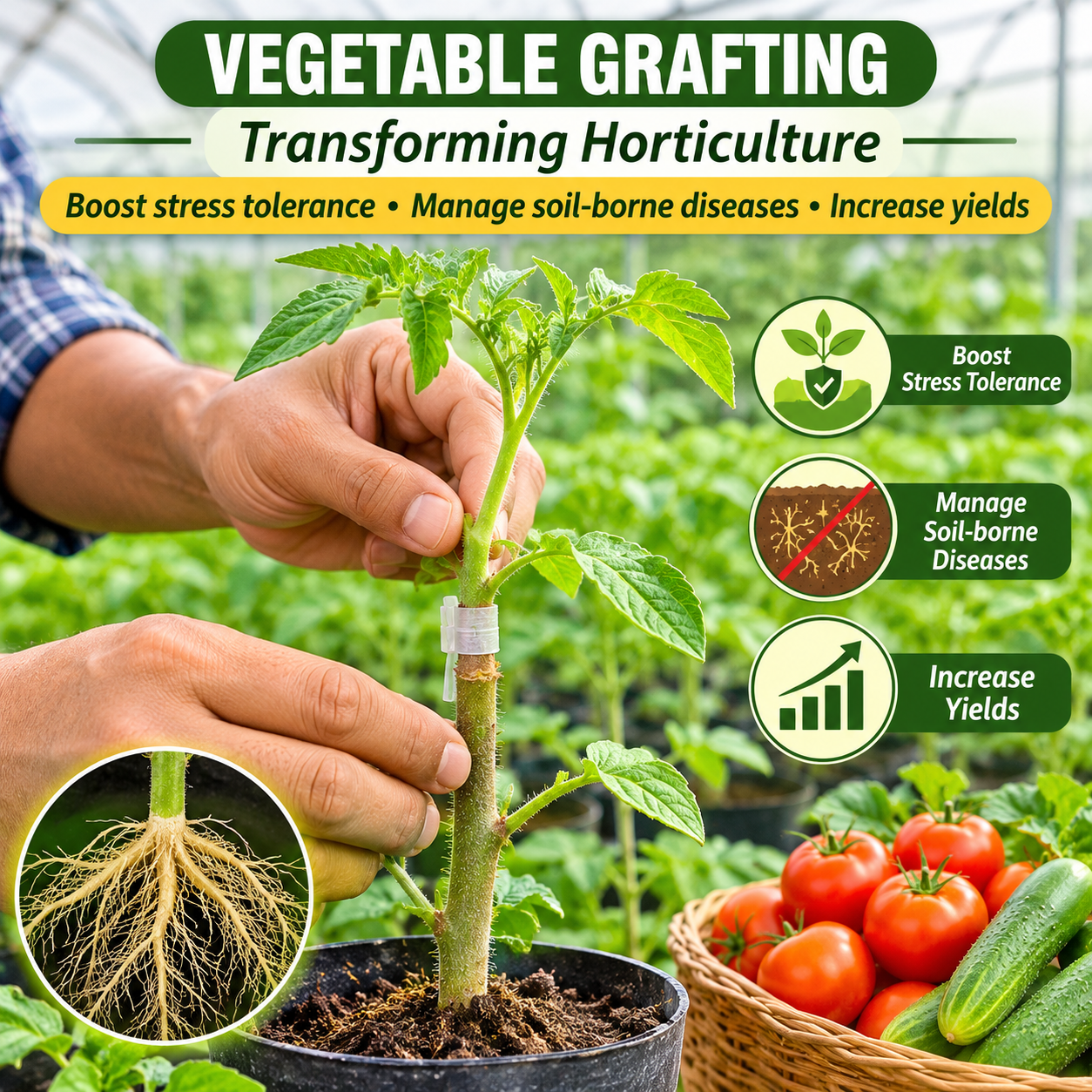
At its core, this solution involves grafting high-yielding commercial vegetable scions onto hardy, stress-tolerant rootstocks. This technique allows the plant to retain its desirable fruit characteristics while benefiting from the robust root system of a different plant. By doing so, farmers can overcome significant challenges such as bacterial wilt, fusarium, drought, and extreme temperatures, all while managing declining soil health without relying on excessive pesticides.
Key Benefits: More Yield, Less Input
The advantages of adopting grafted vegetables are substantial and multifaceted:
- Increased Yields: On-farm trials have demonstrated a remarkable 40–150% increase in yield compared to non-grafted crops, even under stress-prone conditions.
- Stress Tolerance: Grafted plants show enhanced tolerance to drought, salinity, heat, and waterlogging—conditions common in dryland regions.
- Disease Control: The approach effectively controls biotic stresses like bacterial wilt, fusarium wilt, and root-knot nematodes.
- Food Safety: It reduces the uptake of heavy metals in produce, ensuring safer food for consumers.
- Sustainability: Vegetable grafting promotes low-input, eco-friendly farming. It is compatible with both open fields and protected cultivation systems for crops like tomato, brinjal, chilli, cucumber, watermelon, and bottle gourd.
Proven Impact and Broad Applicability
The success of this solution is not limited to a single region. While the Rayalaseema region of Andhra Pradesh has seen remarkable adoption—with trials covering over 650 hectares and over 65 lakh grafted seedlings distributed—the technology is designed for far broader impact.
This solution is well-suited for semi-arid, arid, and rainfed regions across states including Maharashtra, Karnataka, Odisha, Telangana, and Madhya Pradesh, where water scarcity and soil degradation are common. It is also applicable in peri-urban zones and areas with light-textured soils where vegetables suffer from frequent replanting failures due to disease.
Across 540 farmers’ fields, grafted tomato and brinjal showed better crop vigour, uniformity, and marketability. In Andhra Pradesh alone, adoption over six years (2018–2024) generated a yield enhancement of over 20,000 tonnes and Rs. 30 crores in additional farmer income. With appropriate rootstock-scion combinations, the solution can be expanded to other parts of South Asia and Sub-Saharan Africa facing similar agro-ecological stress.
Scalability and the Road Ahead
Vegetable grafting is highly scalable due to its adaptability across solanaceous and cucurbitaceous crops, regions, and existing nursery systems
(Reference: ISSCA, Scalable Technology and Innovations. Vegetable grafting and Dryland Agriculture. ICRISAT)
Building the Skills
For those looking to enter this space in agri-entrepreneurship in vegetable grafting, IHT, Greater Noida provides training for a vegetable grafting course with practical exposure through hands-on training—an ideal starting point for aspiring entrepreneurs. The course combines expert led classroom session with practical, hands on training enabling participants to develop the expertise required to establish, manage or a expand a Commercial grafting enterprise.
The course covers post grafting entrepreneurship like cost of production per seedling, pricing, profit margins, break even, business models, marketing & nursery licensing/registration overview.
Enquire now Phone +91-8130997511 Email: enquiry@iht.edu.in

Leave A Comment