

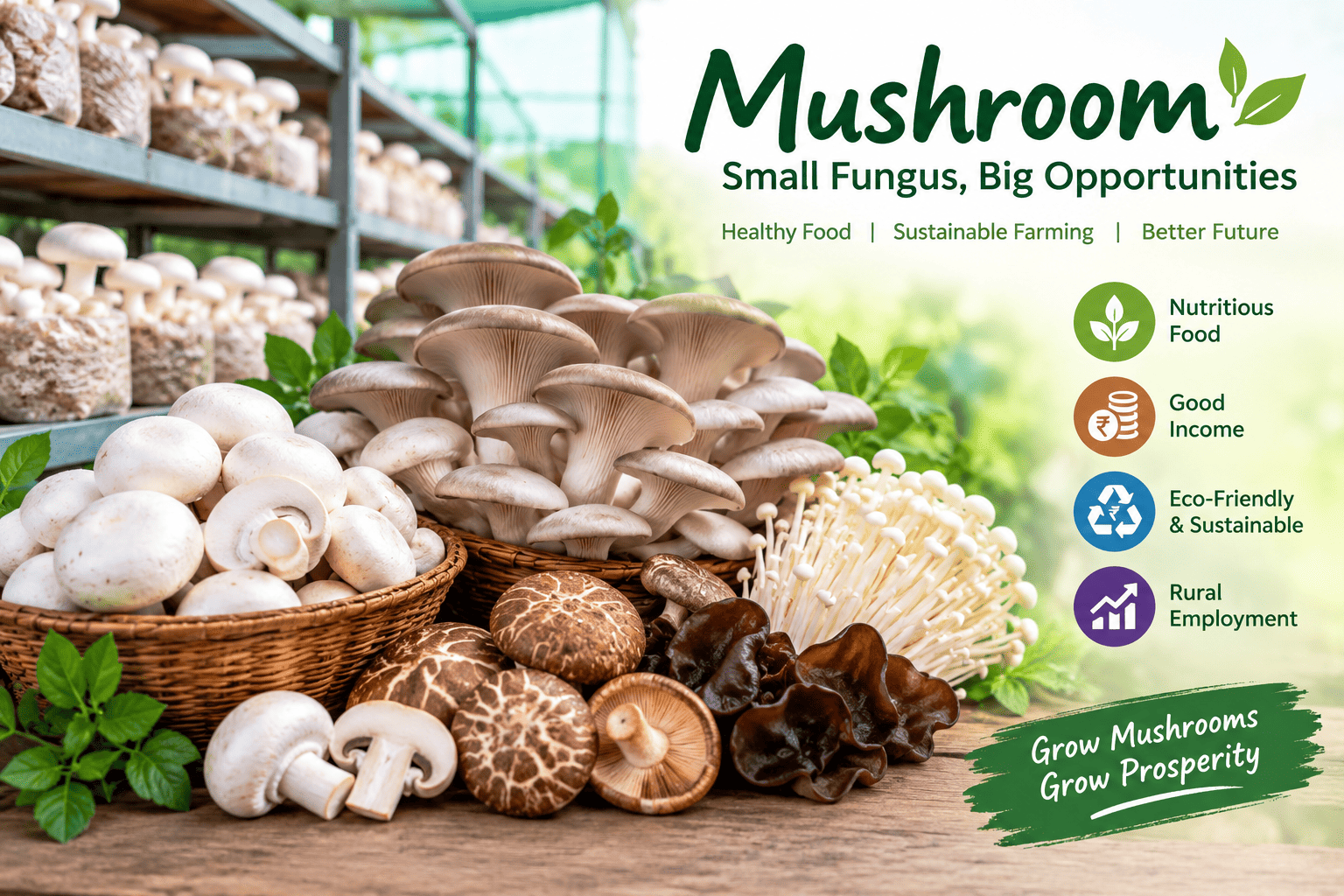
Mushrooms have moved from the margins of the Indian plate to the centre of a booming business opportunity. Once a garnish in regional dishes, they’re now hailed as a “superfood” — a protein alternative, wellness ingredient, and one of India’s most promising small-business ventures.
Why Mushrooms Matter
Nutritionally, they’re a powerhouse: low in calories and fat, yet rich in protein, fibre, B-vitamins, potassium, selenium, and copper. Some varieties are among the few natural plant-based sources of vitamin D — a key reason government programs promote them as a nutrient-dense food.
Culinary versatility is unmatched — from button mushrooms in Continental sauces to oyster mushrooms in Manchurian, and premium shiitake and cordyceps in upscale menus and nutraceuticals. Their meaty texture makes them a natural substitute in curries, kebabs, biryanis, and burger patties, perfectly suiting India’s shift toward vegetarian and flexitarian diets- a flexible, semi-vegetarian eating plan that focuses on plant-based foods while allowing meat and animal products in small amounts.
Sustainability is another draw: mushrooms grow on agricultural waste like straw, sawdust, and husk, requiring far less land and water than conventional farming.
The Business Opportunity
Strong growth curve: India’s mushroom market is estimated in the hundreds of millions to over a billion dollars, with projections of 12–20% CAGR driven by urban demand, hotels, exports, and health-focused consumers.
Supply-demand gap: Domestic production trails well behind demand — meaning new, well-run farms can usually find buyers without much difficulty.
Low barrier to entry: A spare room or shed of a few hundred square feet is enough to start. Harvest cycles are fast (30–45 days), so returns come sooner than traditional farming.
Support ecosystem: Central and state governments, agricultural universities, and NABARD-linked schemes offer subsidies, training, and financing.
Value-added models: Beyond fresh mushrooms, opportunities include processed products (pickles, powders, ready-to-cook mixes), spawn production, medicinal mushrooms, and exports (particularly for APEDA-registered producers).
Simple compliance: A basic FSSAI registration is all that’s needed to get started legally.
Who Can Tap This Opportunity?
- Urban entrepreneurs setting up compact, climate-controlled units
- Women’s self-help groups seeking home-based income
- Rural and semi-rural farmers wanting a high-value, low-land crop
- Agri-tech startups building automated systems, spawn labs, or D2C brands
Get Trained
The Institute of Horticulture Technology, Greater Noida, conducts a 4-day Mushroom Training covering cultivation, processing, and marketing — including compost making, pasteurization, spawn production, casing, nutrition, pest management, and value-added products, plus a visit to a commercial growing unit.
For details, visit www.iht.edu.in or contact +91-011-46604988 / +91-8130997511.
Contact Us:
Telephone: +91-11-46604988
Phone: +91-8130997511
Email: enquiry@iht.edu.in

Leave A Comment