
Wilt disease in tomato, brinjal, and chilli is no longer just a Fusarium problem—a complex of soil-borne pathogens is at play. While Ralstonia solanacearum remains the most destructive bacterial wilt agent, causing yield losses ranging from 2–100% depending on the crop and strain, recent surveys in India have also flagged Enterobacter species as emerging vascular wilt pathogens in tomato and brinjal, often misdiagnosed as Ralstonia. Alongside these bacterial threats, Verticillium dahliae and V. albo-atrum persist in soils for over a decade through microsclerotia and dormant mycelium, targeting solanaceous crops—eggplant and chilli among the most sensitive hosts.
To overcome it, a quiet revolution is taking root especially in Chhattisgarh. For decades, Indian farmers have battled unpredictable monsoons, soil-borne diseases, and shrinking profit margins. Simultaneously, a new generation of bio-entrepreneurs is looking for sustainable, high-impact business models.
The bridge connecting these two challenges is a sophisticated yet accessible technology: Vegetable Grafting.
Far from being just a gardening trick, vegetable grafting is emerging as the golden thread that weaves together sustainable entrepreneurship and agricultural prosperity. It offers a “new beginning” for Indian bio-entrepreneurs and a pathway for farmers to not just survive, but thrive by harnessing double yields.
What is Vegetable Grafting?
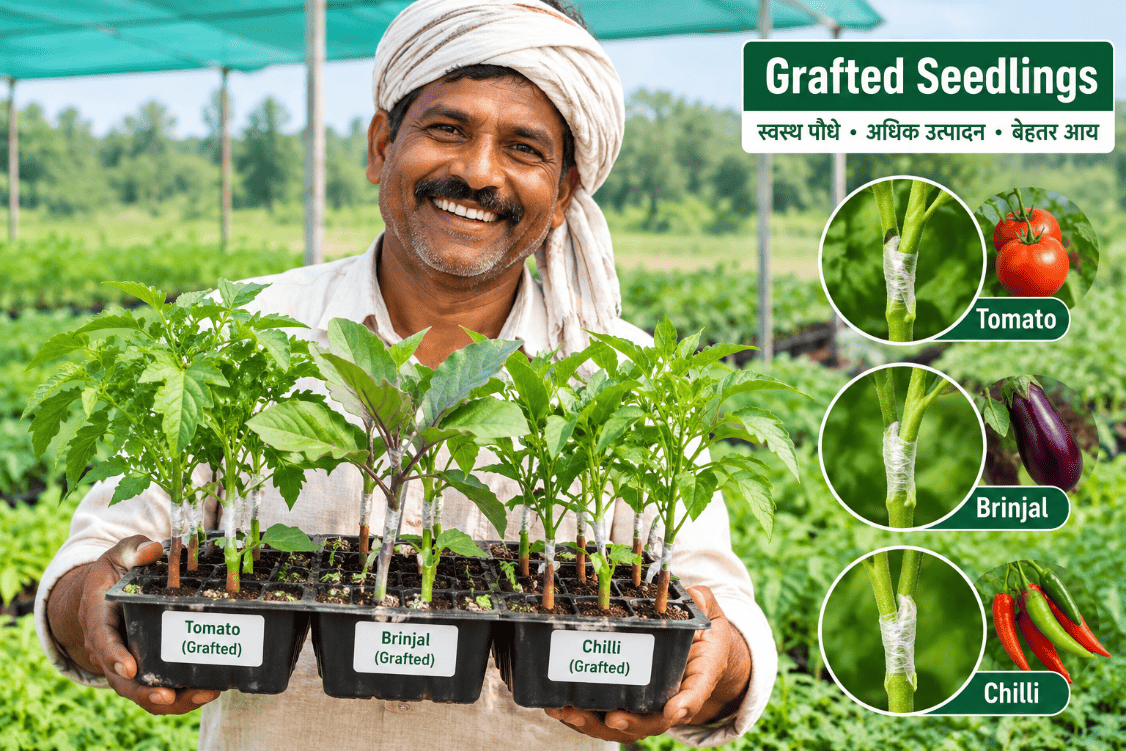
At its core, vegetable grafting is a surgical horticultural technique. It involves joining the root system of one plant (the rootstock) with the shoot system of another (the scion).
- The Rootstock: Chosen for its strong roots, resistance to soil-borne diseases (like bacterial wilt and fusarium), and tolerance to abiotic stress (like salinity and drought).
- The Scion: Chosen for its high yield, superior fruit quality, and market preference.
The result is a “super plant” that has the strong, resilient foundation of the rootstock and the productive, high-value fruits of the scion.
The Opportunity for Indian Bio-Entrepreneurs
For bio-entrepreneurs, this isn’t just agriculture; it is a scalable, sustainable business opportunity.
- The “Seedling Factory” Model
The traditional method of growing vegetables is risky and inconsistent. Grafting allows entrepreneurs to set up specialized nurseries that produce high-quality, disease-free grafted seedlings. This shifts the risk from the farmer to the entrepreneur, who can control the environment (greenhouses) to ensure uniform, vigorous plantlets. It is a recurring revenue model—farmers need new seedlings every season. - Sustainable Business Practices
This is “Bio” entrepreneurship at its finest. Grafted plants significantly reduce the need for chemical pesticides and fumigants. By choosing rootstocks that are resistant to soil pathogens, entrepreneurs are effectively selling a biological solution to a chemical problem. This aligns with the global shift toward organic and residue-free farming. - Value Addition
By selling a grafted seedling, you are not just selling a plant; you are selling insurance. You are selling a guarantee of higher yield and better quality. This allows entrepreneurs to command a premium price compared to standard seedlings.
The Promise for Farmers: Harnessing Double Yield
For the Indian farmer, the proof is in the harvest. Vegetable grafting is delivering transformative results:
- Disease Resistance: Soil-borne diseases often wipe out entire crops. Grafted plants bypass these pathogens, ensuring the plant survives to maturity.
- Abiotic Stress Tolerance: Grafted rootstocks can help plants survive in saline soils or waterlogged conditions, expanding the areas where high-value crops can be grown.
- Yield & Vigour: Grafted plants have a more robust root system, leading to increased water and nutrient uptake. This results in significantly higher yields—often double that of non-grafted plants—and a longer harvest period.
- Quality & Shelf Life: Farmers can grow the varieties the market wants (e.g., high-sugar melons, bright-coloured capsicums) without worrying about weak root systems. The fruit often has a longer shelf life, reducing post-harvest losses.
The Road Ahead
While the potential is immense, the adoption of vegetable grafting in India requires a collaborative ecosystem. Bio-entrepreneurs need to work hand-in-hand with:
- ICAR & SAUs: For research on rootstocks suited to Indian climates (e.g., for tomatoes, brinjals, cucumbers, and capsicum).
- Government Schemes: To subsidize the cost of grafted seedlings for small and marginal farmers, making the technology accessible.
- Training & Extension: To educate farmers on the benefits and the slightly different management practices required for grafted crops.
Conclusion
Vegetable grafting is more than a technical fix; it is a mindset shift. It moves agriculture from a gamble to a science, and from a struggle to a sustainable business.
For the Indian bio-entrepreneur, it offers a chance to build a profitable, eco-friendly enterprise. For the Indian farmer, it offers a path to resilience, profitability, and pride. By joining forces, they can cultivate a future where the Indian fields are greener, the yields are higher, and the business of farming is truly sustainable.
It’s time to graft a new future for Indian agriculture.
Contact Us:
Telephone: +91-11-46604988
Phone: +91-8130997511
Email: enquiry@iht.edu.in

Leave A Comment